Snacking With Type 2 Diabetes: A Framework That Works
The hardest part of eating with type 2 diabetes isn't dinner. It's 3 p.m. A two-part rule, smart swaps, and portion math that keeps blood sugar steady.
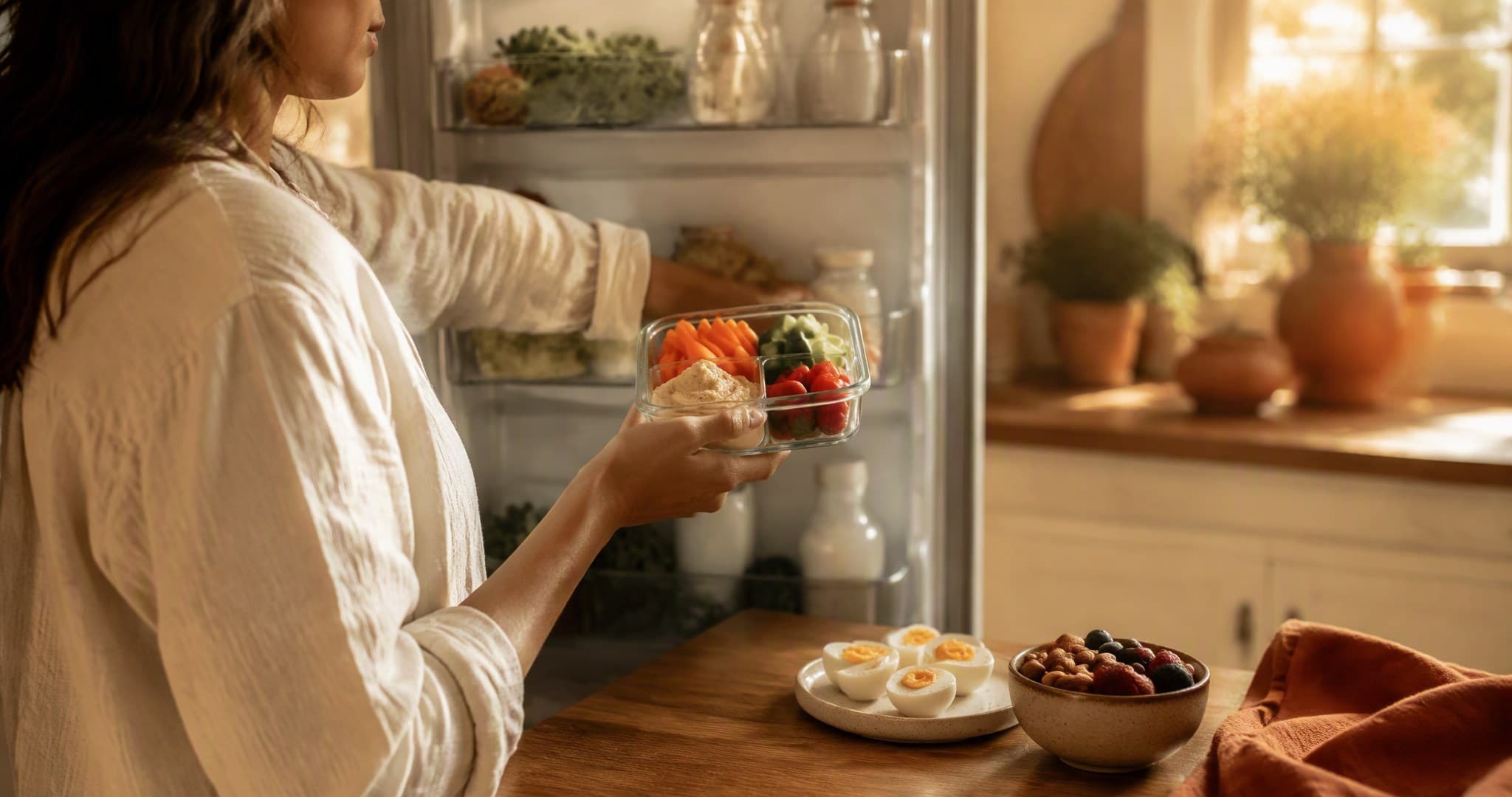
It's 3 p.m. Lunch was hours ago, dinner is hours away, and your stomach has started making its case. This is the moment where eating with type 2 diabetes actually gets decided: not at the big, planned meals, but in the gap between them, when you're hungry and whatever is closest wins.
The good news: snacking with type 2 diabetes doesn't require willpower, a spreadsheet, or a lifetime of celery sticks. It requires a framework: one rule with two parts, a ladder of snacks ranked by effort, and a little portion math you can do in your head. That's what this is.
One thing up front: if you take insulin or a sulfonylurea, your snack timing and carb targets can shift with your medication. Treat everything here as a framework to bring to your care team, not a dosing guide.
Why Snacking Is the Hardest Part
There's a Grand Canyon-sized gap between "eat healthy" and "it's 3 p.m. and I'm starving." Most advice lives comfortably on the first part and goes quiet on the second. And blood sugar doesn't care about your willpower: go too long without eating and your energy dips, your judgment gets fuzzy, and the vending machine starts looking like a reasonable life choice. That's not a character flaw. That's physiology.
Meanwhile, most diabetes snack advice swings between two unhelpful extremes: too restrictive (celery sticks forever, joy optional) or too permissive ("just count carbs," with zero context about what those carbs arrive with). Neither survives contact with a real Tuesday, and both feed the same cycle:
The Crash-and-Binge Cycle
The way out isn't trying harder inside the cycle. It's stepping out of it. Meals carry most of that load, which is why diabetes meal plans built around stable blood sugar make snacking easier too: when breakfast and lunch hold you steady, the 3 p.m. snack stops being an emergency and starts being a strategy. For the full week, here's a 7-day diabetes meal plan built on the same idea.
The Two-Part Rule
Here's the whole framework in one sentence: every snack needs protein or fat to slow glucose absorption. Every snack needs fiber to blunt the spike.
These are not two separate rules you pick between. They work together. Protein and fat slow how fast food leaves your stomach, so glucose trickles into your bloodstream instead of flooding it. Fiber puts up a second speed bump and keeps you full longer. A snack that hits both parts buys you 2–3 hours of steady energy: no spike, no crash, no 4 p.m. rummaging.
| Protein or Fat | + Fiber | = Stable Snack |
|---|---|---|
| Slows glucose absorption | Blunts the spike | 2–3 hours of steady energy |
| Eggs, cheese, nuts, yogurt, hummus | Veggies, berries, apples, seeds | No crash, no rebound hunger |
You don't need to memorize anything beyond that. Standing in front of the fridge, ask two questions: where's my protein or fat, and where's my fiber? If you can point to both, you're good.
The Snacks That Sound Healthy But Aren't
Before the ladder, a quick clear-out. Some snacks have excellent marketing and terrible blood sugar math. They wear a health halo: words like "oat," "fruit," and "protein" right on the box, while delivering exactly the fast, fiber-free carb hit you're trying to avoid. Here's the honest rundown, and what to grab instead.
Health Halo Swaps
Instead of
Try
Fruit juice — no fiber, pure fructose, spike city
A small apple + string cheese
Granola bars — oats + honey + dried fruit = a carb bomb with a health halo
A handful of almonds + a few berries
Rice cakes, plain — air + starch = fast glucose, no brakes
Peanut butter on celery
Smoothie shop smoothies — three bananas and mango juice is not a snack, it's dessert
Greek yogurt + cinnamon
"Protein" bars with 20 g of sugar — read the label, not the marketing
Hard-boiled eggs + cherry tomatoes
Notice the pattern: it's rarely the food itself that's the problem. It's the food without its entourage. Juice is fruit with the fiber removed. A plain rice cake is starch with nothing to slow it down. Put the protein, fat, and fiber back, and most of these become fine. Which brings us to what to eat instead.
The Snack Ladder
Not all snacks require the same effort, and pretending they do is how good intentions die on busy days. So here's the ladder: three tiers, ranked by how much work they take. Grab from the tier that matches the day you're actually having.
Tier 1: Zero-Prep (Grab and Go)
- Hard-boiled eggs + cherry tomatoes
- String cheese + a small apple
- A handful of almonds + a few berries
- Greek yogurt (unsweetened) + cinnamon
- Edamame (shelled, straight from the fridge)
Why this works: every option here pairs a protein or healthy fat with a fiber source, and requires nothing but a fridge door and ten seconds.
Tier 2: One Minute (Minimal Assembly)
- Hummus + raw veg (carrots, peppers, cucumber)
- Tuna salad on cucumber rounds
- Cottage cheese + flaxseed
- Peanut butter on celery
- Deli turkey roll-ups with mustard
Why this works: one minute of assembly buys you bigger portions and more staying power: the chickpeas in hummus and the flaxseed in cottage cheese add fiber on top of the protein.
Tier 3: Five Minutes (Worth the Effort)
- Avocado half with everything-bagel seasoning
- Smoked salmon + cream cheese on cucumber
- Mini caprese: mozzarella ball + cherry tomato + basil
- Egg muffin (batch-prepped) reheated
- Chia pudding cup (batch-prepped)
Why this works: these feel like real food, because they are. The fats in avocado, salmon, and chia are the slowest-burning fuel on the ladder, so these hold you the longest.
Notice what's not on the ladder: anything that requires cooking on the spot. Snacks should fit into the cracks of your day, not become a project.
How to Eyeball 15 Grams
You don't need a food scale at 3 p.m. You need one number and a feel for what it looks like.
The number is 15. About 15 grams of carbohydrate is a reasonable starting point for a snack, not a hard limit, just a place to begin. (Even the CDC's diabetes guidance starts with the same idea: know roughly how much carbohydrate you're eating, and the rest gets easier.)
Source: American Diabetes Association. "Carbohydrate Counting." https://diabetes.org/healthy-living/recipes-nutrition/carb-counting
One distinction worth saying out loud: 15 grams is also the amount of fast-acting carbohydrate commonly used to treat low blood sugar: the "15 rule." This section is a portion guide for planned, steady snacks. It is not the treatment for a low. If you're treating a low, follow the plan your care team gave you, not this article.
| Roughly 15 g of carbs looks like | |
|---|---|
| 1 small apple | 1 cup of berries |
| 1 rice cake | 6 crackers |
| ½ banana | ½ cup of juice (if you must) |
Now the part that makes this livable: the protein/fiber multiplier. If your snack carries 10 or more grams of protein, or 5 or more grams of fiber, you can be more flexible on the carb number. That small apple with string cheese? The cheese changes the math. Those berries stirred into Greek yogurt? Different equation entirely. The carbs arrive escorted, and escorted carbs behave.
And if doing this math for every snack, every day, sounds like a second job. It is. A structured diabetes meal plan handles the macro math for you, so the numbers are already right when you open the fridge.
Timing Matters More Than You Think
The same snack can land completely differently depending on when you eat it. Three timing ideas worth keeping:
The 3–4 hour sweet spot. Going much longer than four hours without eating sets you up for the crash-and-binge cycle from earlier. A snack at the three-hour mark isn't weakness. It's prevention. You're not feeding hunger; you're heading it off.
Moving vs. sitting. Muscles that are working pull glucose out of your bloodstream with less insulin, so your body handles carbs more gracefully around activity. If you're going to have the higher-carb option, have it before you move.
Evenings. Poor sleep makes next-day blood sugar harder to manage, so the 10 p.m. graze can cost you twice. This isn't a lecture: if you're genuinely hungry at night, have something small with protein: a little cottage cheese, a few nuts, and call it. The goal is a planned snack, not a cabinet door left open.
Batch Prep for the Snack Drawer
The snack ladder works best when the ladder is already stocked. Twenty minutes on a Sunday covers your whole week:
- Boil 6 eggs (they keep a week in the fridge, unpeeled)
- Portion nuts into small containers or bags, grab-sized, not jar-sized
- Make 3–4 chia pudding cups (chia seeds + milk + a little vanilla, fridge overnight)
- Cut veg: carrots, peppers, cucumber into a container of water so they stay crisp
That's it. Tier 1 and most of Tier 2 now require zero thought all week. Then build your snack emergency kit, the stash that lives in your desk, car, or bag for the days that go sideways: a small bag of almonds, a pack of roasted chickpeas or edamame, maybe a low-sugar protein bar you've actually read the label of. The emergency kit exists so that "starving and stranded" never becomes "whatever the gas station has."
And if you'd rather not think about any of this. Tell Chef Wize your schedule and he'll build the snack prep into your weekly plan. The eggs, the portions, the grocery list, all of it.
If PCOS Is Part of Your Picture Too
Type 2 diabetes and PCOS often share the same underlying engine: insulin resistance. In both, the body has to work harder to move glucose out of the bloodstream, which is why the same mechanics (pairing carbs with protein and fiber, avoiding naked starch, not going too long between eating) show up in the guidance for both conditions. It also means the work you do for one tends to help the other. The same blood-sugar principles apply to PCOS, so if you're managing both, you don't need two snack systems. You need one good one. There are also PCOS meal plans that balance blood sugar built on this exact framework.
Frequently Asked Questions
References
- American Diabetes Association. "Carbohydrate Counting." https://diabetes.org/healthy-living/recipes-nutrition/carb-counting
- Centers for Disease Control and Prevention. "Diabetes Meal Planning." https://www.cdc.gov/diabetes/
- Evert AB, et al. (2019). "Nutrition Therapy for Adults With Diabetes or Prediabetes: A Consensus Report." Diabetes Care. https://doi.org/10.2337/dci19-0014
- Bell KJ, et al. (2015). "Impact of Fat, Protein, and Glycemic Index on Postprandial Glucose Control in Type 1 Diabetes." Diabetes Care. https://doi.org/10.2337/dc14-2824
Keep reading
15 Blood-Sugar-Friendly Breakfasts for Steady Mornings
Sick of the 10 a.m. blood sugar crash? These 15 breakfast ideas for diabetics pair protein, fiber, and fat for steady mornings. Find your next favorite.
The Low-GL Way of Eating: Blood-Sugar-Friendly Without Counting Anything
Struggling with 3 p.m. crashes on a low glycemic diet? The real fix is glycemic load. Learn low-GL swaps that keep blood sugar steady, without counting a thing.
This content is intended for educational purposes and should not replace individualized medical advice. Read our editorial standards.