The Low-GL Way of Eating: Blood-Sugar-Friendly Without Counting Anything
Struggling with 3 p.m. crashes on a low glycemic diet? The real fix is glycemic load. Learn low-GL swaps that keep blood sugar steady, without counting a thing.
You found the low glycemic diet list, printed it, and stuck it to the fridge with a magnet. You ate the foods in the green column, avoided the flagged ones, and waited to feel different. Then lunch came and went, the 3 p.m. fog rolled in, and by five you were staring into the snack drawer again. If that kitchen sounds familiar, take a breath. The problem was probably never your discipline. It was the list itself.
Most blood-sugar-friendly advice hands you a ranking system that leaves out a crucial piece of information, and you cannot make up for missing data with effort. The fix is not another diet, another app, or another round of restrictions. It is a more accurate way of judging the food on your plate, one that matches how you actually eat.
Why the Glycemic Index Left You Hungry at 3 p.m.
Nearly every low glycemic diet plan leans on the glycemic index (GI), a score that measures how quickly a carbohydrate raises blood sugar compared with a reference food, usually pure glucose (Harvard T.H. Chan School of Public Health). White bread scores high. Lentils score low. So far, so useful.
Here's the trap. The GI measures speed, not amount. It tells you how fast a food's carbohydrates reach your bloodstream, but it says nothing about how many carbohydrates a real portion contains. Your body does not respond to speed alone. It responds to the total amount of glucose that lands in your blood.
Watermelon is the classic example. It carries a high GI, in the low 70s, because its sugars are absorbed quickly. But a normal serving of watermelon is mostly water and fiber, so its carbohydrate load is small. The international reference table for glycemic values lists a 120-gram serving of watermelon with a glycemic load of about four, while puffed rice cakes, cooked, ground, and puffed into near-instant absorption, score close to 80 (Foster-Powell et al., 2002).
Judged by GI alone, watermelon gets crossed off the list. Watch your blood sugar, and you would probably keep it. Meanwhile, a food that does not even taste like dessert can still wreck your afternoon. That is the blind spot most advice never mentions.
Glycemic Load: The Number That Matches Reality
The correction is glycemic load (GL), a measure that combines the GI with the actual carbohydrate content of a real serving. The formula is simple: GL = (GI × grams of carbohydrate per serving) ÷ 100.
Think of the GI as a speedometer and the GL as the distance your blood sugar actually travels. Speed matters, but distance is what leaves you drained at three in the afternoon.
By the common scale, a per-serving GL of 10 or less is low, 11 to 19 is medium, and 20 or more is high (Oregon State University, Linus Pauling Institute).
The glycemic index itself was first described in 1981 by Canadian researcher David Jenkins and colleagues, who were looking for a better way to help people with diabetes choose carbohydrates (Jenkins et al., 1981). Glycemic load came later, as a companion that accounts for portion size. And it predicts outcomes in real life. In a 1997 study of more than 65,000 U.S. women, those whose diets carried the highest glycemic load were 37% more likely to develop type 2 diabetes over six years of follow-up, even after adjusting for other risk factors (Salmerón et al., 1997). Observational research like this does not prove cause and effect, but it shows the measure means something beyond the theory.
What a Spike Actually Does, and Why You Crash
When you eat a high-GL meal, refined carbohydrate floods your bloodstream quickly. The pancreas responds with a surge of insulin, the hormone that moves glucose into cells. If that surge overshoots, blood sugar drops sharply a couple of hours later.
The high-GL spike-and-crash cascade
That drop is the 3 p.m. fog, the irritability, the urgent hunger that seems to ignore everything you ate. The bigger the spike, the deeper the rebound. The Harvard T.H. Chan School of Public Health describes the same loop: refined carbohydrates raise blood sugar quickly, provoke a large insulin release, and can leave you hungry soon after (Harvard's Nutrition Source).
Low-GL meals interrupt the loop. Starches arrive slowly, held back by fiber and intact food structure, insulin rises gently, and blood sugar stays in a comfortable groove. You stay full longer, energy holds steady, and the snack drawer loses its pull.
Pro tip: If you remember one rule, make it this one: never eat a starch alone. Pair it with protein, fat, or fiber, and the same food behaves differently in your bloodstream.
Eating Low-GL Without Counting Anything
This is where the trap gives way to a workable system. You do not need a calculator. You need a few patterns that do the GL arithmetic for you.
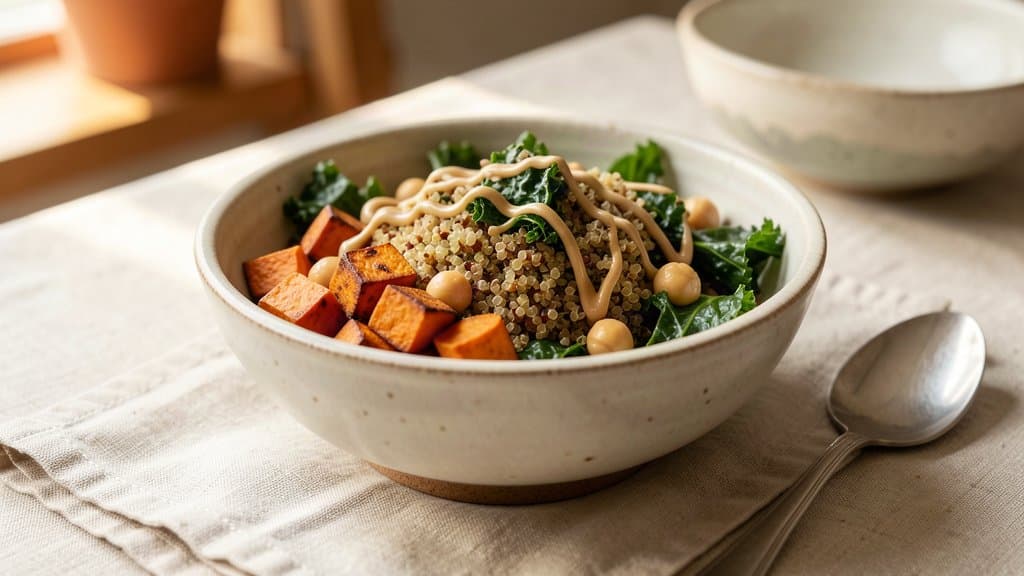
Choose intact grains over refined ones. Steel-cut oats over instant oatmeal, barley or farro over white rice, kernels over flour. Grinding and puffing remove the structure that slows glucose absorption.
Make vegetables the center of the plate. Fill half your plate with non-starchy vegetables, a quarter with protein, and a quarter with a starchy carbohydrate, plus a thumb of healthy fat. The vegetables add fiber and bulk. The protein and fat slow stomach emptying. The starch comes in a portion whose GL stays modest.
Keep fruit whole, never juiced. Blending or juicing strips the fiber and delivers the sugar in a rush. A whole orange beats orange juice every time.
Swap foods instead of flexing willpower.
Low-GL swaps that do the math for you
Instead of
Try
White rice
Barley, farro, or quinoa
Instant oatmeal
Steel-cut or rolled oats
White bread or bagel
Whole-grain sourdough or 100% rye bread
Fruit juice
Whole fruit
Flaked breakfast cereal
Bran cereal or cooked whole grains
Mashed white potato
Sweet potato with the skin, or chickpeas
Pair every carbohydrate with protein, fat, or fiber. The same amount of carbohydrate produces a smaller blood sugar response when it travels with other nutrients. Bread with nut butter. Rice with beans. Yogurt with berries.
Here's the trap within the trap: many foods marketed as clean or light are exactly where a high GL hides. Granola, rice cakes, dried fruit, and fruit-on-the-bottom yogurt do not taste like dessert, so they do not register as a glucose load. But their processing has already done the slow work your body would otherwise have to do. The clean-eating aisle never told you that processing does the digesting for you.
One more principle, and it matters as much as any swap: low-GL eating is about the pattern, not the single food. A high-GL meal now and then does not undo a mostly steady diet. What makes the difference is the default.
FAQ
Frequently Asked Questions
Key Takeaways
| Takeaway | Why it matters |
|---|---|
| The GI measures speed; the GL measures speed plus serving size | Judging food by GI alone is the trap that causes 3 p.m. crashes |
| A per-serving GL of 10 or less is the low range | A memorable anchor you can estimate with patterns, not math |
| Fiber, protein, and fat slow glucose absorption | Pairing carbs lowers a meal's overall glycemic response |
| Eat whole fruit and intact grains; skip juice and puffed cereals | Processing removes the structure that keeps glucose steady |
| Half vegetables, quarter protein, quarter starch | Portion control that does the GL work for you |
Make Steady Energy the Default at Your Table
The low-GL way of eating is not a diet you go on and off. It is a set of defaults: half your plate vegetables, a quarter protein, a quarter intact starch, whole fruit instead of juice. Once those defaults are in place, dinner decisions make themselves, and the 3 p.m. fog has nothing to grab onto.
That ease is the entire point. It is also the idea behind Wizemeals: plates built so the steady choice is the easy choice, and none of the math ever lands on your kitchen counter. Tonight, try one swap from the list above. Then let the steadiness convince you to try the next one.
References
- Foster-Powell K et al. (2002). International table of glycemic index and glycemic load values: 2002. The American Journal of Clinical Nutrition. https://doi.org/10.1093/ajcn/76.1.5
- Jenkins DJA et al. (1981). Glycemic index of foods: a physiological basis for carbohydrate exchange. The American Journal of Clinical Nutrition. https://doi.org/10.1093/ajcn/34.3.362
- Salmerón J et al. (1997). Dietary fiber, glycemic load, and risk of non-insulin-dependent diabetes mellitus in women. JAMA. https://doi.org/10.1001/jama.277.6.472
- Harvard T.H. Chan School of Public Health. Carbohydrates and blood sugar. https://www.hsph.harvard.edu/nutritionsource/carbohydrates/carbohydrates-and-blood-sugar/
- Oregon State University, Linus Pauling Institute. Glycemic index and glycemic load. https://lpi.oregonstate.edu/mic/food-beverages/glycemic-index-glycemic-load
Keep reading
15 Blood-Sugar-Friendly Breakfasts for Steady Mornings
Sick of the 10 a.m. blood sugar crash? These 15 breakfast ideas for diabetics pair protein, fiber, and fat for steady mornings. Find your next favorite.
The Low Glycemic Foods List, Aisle by Aisle
Lost in the cereal aisle with a low glycemic foods list that doesn't match the store? This one is rebuilt aisle by aisle: produce, intact grains, protein, the freezer, and the cart rides worth skipping.
This content is intended for educational purposes and should not replace individualized medical advice. Read our editorial standards.