Sodium Swaps That Actually Taste Good: Heart-Healthy Guide
'Just use less salt' is technically correct and practically useless. The swap ladder — substitutes, flavor builders, technique — plus a 7-day taste reset.
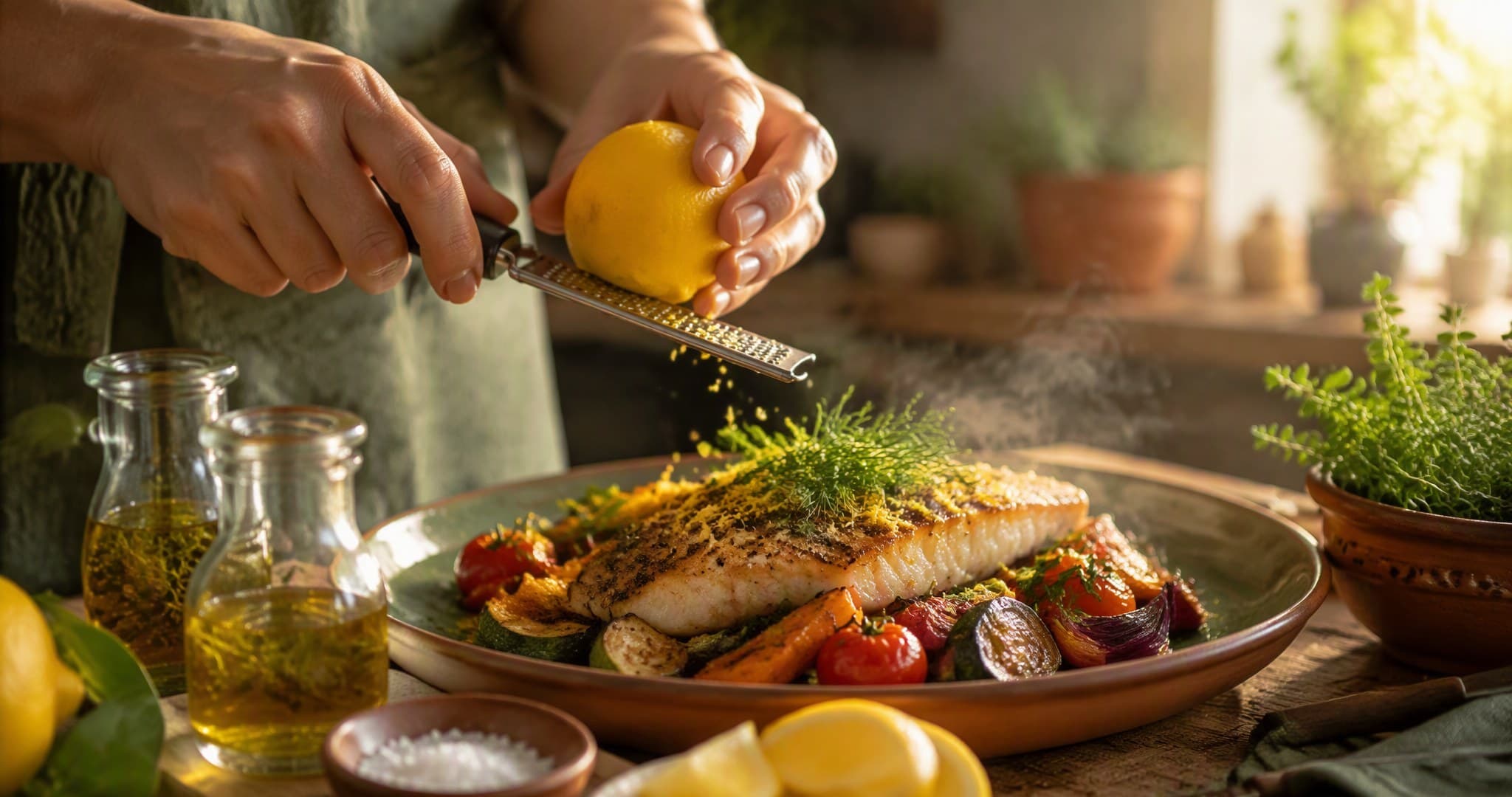
Somewhere along the way, "eat for your heart" got translated into "say goodbye to flavor." Your doctor mentions sodium, you picture a future of steamed nothing, and suddenly that blood pressure reading feels personal.
Here's what nobody tells you: salt was never the flavor. It was the volume knob. It turns everything else up, and the moment you learn which other tools do the same job, cooking with less sodium stops being a punishment and starts being a skill. This guide is the ladder: what to swap directly, what builds flavor instead of salt, and which techniques change the game entirely.
If you'd rather skip the theory and have the math done for you, get your personalized heart-healthy meal plan. But if you want to actually own this in your kitchen, keep reading.
The Problem With "Just Use Less Salt"
Every piece of sodium advice eventually lands on the same four words: just use less salt. And technically? Correct. Practically? Useless.
Food without salt tastes like food without salt. You already knew that. You tried it for a week, everything tasted like wet cardboard, and the shaker crept back onto the table. That's not a willpower failure. It's a strategy failure. Removing an ingredient that does three jobs and replacing it with nothing was never going to work.
The real goal isn't subtraction. It's replacement. Salt enhances flavor, controls texture, and preserves food, and each of those jobs has other tools that can do it. Once you start thinking in swaps instead of sacrifices, the whole thing clicks. It's the same philosophy behind heart-healthy meal plans built around real flavor: the food has to taste good first, or the plan doesn't survive past Tuesday.
The Bland-Food Spiral
What Sodium Actually Does in Food (Beyond "It Tastes Salty")
Before the ladder, thirty seconds of food science. Because a swap that ignores the function always fails.
Salt is a flavor amplifier, not just a flavor. It boosts sweetness, deepens umami, and tames bitterness. That's why a pinch of salt makes tomatoes taste more tomato-y and makes dark chocolate taste richer. When you pull it out, you don't just lose "salty." The volume drops on everything.
Salt controls moisture and texture. It's what gives bread its structure, cured meats their bite, and pickles their crunch. This is the job most people forget about.
Salt preserves. It inhibits bacterial growth, which is why it ended up in basically every packaged food ever made.
Why does this matter? Because lemon juice replaces salt's brightness, miso replaces its depth, and neither replaces its preservation or texture work. Match the swap to the job and you win. Mismatch them and you get flat soup with a squeeze of lemon on top, wondering what went wrong.
Source: Centers for Disease Control and Prevention. "About Sodium and Health." https://www.cdc.gov/salt/about/index.html
The Swap Ladder
Here's the heart of it: three tiers, ranked from "change one ingredient" to "change how you cook." Start at Tier 1 this week. Work your way down as it gets comfortable.
Tier 1: Direct Substitutes (same role, less sodium)
These are one-for-one swaps. Nothing about your cooking changes except the shaker, the bottle, or the box.
Tier 1 · Direct Substitutes
Instead of
Try
Kosher salt (Morton)
Diamond Crystal kosher salt — same volume, about 1/3 less sodium by weight thanks to its hollow crystal structure
Table salt
Lite Salt — a potassium chloride blend with about 50% less sodium
Soy sauce
Coconut aminos — about 70% less sodium, with a subtle sweetness
Bouillon cubes
Low-sodium bouillon or homemade stock — you control the salt
Pickles
Quick-pickled veg with rice vinegar — bright crunch, no salt brine needed
Why this works: these swaps keep salt's flavor job filled while cutting the actual sodium. You're changing the delivery vehicle, not the experience.
Tier 2: Flavor Builders (replace salt's flavor role with something else)
This is where cooking gets fun. Each of these does one of salt's jobs: brightness, depth, that "finished" feeling. All with little or no sodium.
Tier 2 · Flavor Builders
Instead of
Try
A finishing pinch of salt
Citrus zest + juice (lemon, lime, orange) — replaces salt's brightness on fish, chicken, and vegetables
Salt to "wake up" a dish
Vinegars (sherry, rice wine, apple cider) — acid stimulates the palate the same way salt does
Parmesan sprinkle
Nutritional yeast — cheesy, umami-rich, naturally sodium-free
Salt-heavy soup base
Miso paste in small amounts — deep savory base for soups, marinades, and dressings
Bacon for smokiness
Smoked paprika + garlic powder — the "bacon effect" without the sodium bomb
Salt for complexity
Fresh herbs (thyme, rosemary, basil, cilantro) — aromatic layers that distract from missing salt
A last-minute salt sprinkle
Toasted sesame oil — a few drops at the end deliver the "finish" salt used to provide
Why this works: your tongue reads acid, umami, and aroma as "seasoned." Fill those channels and the salt channel gets a lot less loud.
Tier 3: Technique Swaps (change the method, not just the ingredient)
The deepest tier, and the one that makes the biggest difference. Here you're not swapping an ingredient at all. You're swapping a habit.
Tier 3 · Technique Swaps
Instead of
Try
Boiling vegetables
Roasting at higher heat — caramelization creates sweetness that compensates for less salt
Salt brine on meat
Dry-brine with herbs — rosemary and garlic rubbed in overnight, flavor without the sodium load
Adding spices late
Toasting spices in oil first — blooming releases flavor compounds salt would otherwise carry
A finishing salt sprinkle
Finishing with texture — crunchy nuts, seeds, or fried shallots make your mouth too busy to miss the salt
Salting the pan sauce
Using the fond — deglaze with wine or stock to capture concentrated flavor instead
Why this works: browning, blooming, and texture build flavor from scratch. So the dish arrives already loud, and salt stops being the only microphone.
Want this done for you? Get your personalized heart-healthy meal plan. Built around your tastes, with the sodium math already handled.
The Hidden Sodium Traps
Plot twist: the salt shaker is not your main problem. Bread and rolls are the number-one source of sodium in the American diet. Not because they're salty-tasting, but because we eat them constantly. The traps below are where sodium actually hides, plus which tier handles each one.
- Bread and rolls — a single slice can carry 150–230 mg, and nobody eats one slice. Swap: bake with Tier 1 lite salt, or lean on whole-grain breads labeled low-sodium.
- Restaurant meals — chefs salt aggressively at every stage; the same dish at home typically uses 40–60% less. Swap: ask for sauces on the side, then finish at the table with a Tier 2 squeeze of lemon.
- "Low sodium" processed foods — many compensate with sugar or potassium chloride that reads metallic. Swap: skip the engineered version and build the real thing with Tier 2 and Tier 3.
- Condiments — ketchup, mustard, salad dressing, hot sauce. Tablespoon by tablespoon, they quietly add hundreds of milligrams. Swap: the miso-ginger dressing from the batch-prep section below.
- Cheese — hard cheeses are concentrated salt. Swap: soft cheeses like ricotta and fresh mozzarella are naturally much lower — and a shower of nutritional yeast covers the rest.
The 7-Day Reset
This is not a challenge. It's a calibration. The goal is discovering what you actually miss versus what you assumed you needed. Most people are genuinely surprised by the difference.
- Days 1–2: Notice where salt lives. Read labels, taste food before salting it, and identify your top three sodium sources. No changes yet. Just data.
- Days 3–4: Swap your shaker. Replace the table salt with an herb blend or a citrus finishing salt (recipe below). Season once, then taste.
- Days 5–6: Build one Tier 2 flavor base. Make a jar of herb oil, citrus salt, or miso dressing and use it twice.
- Day 7: Cook one full meal using only Tier 2 and Tier 3 techniques. No added salt. Roast hot, bloom your spices, finish with acid and crunch.
Source: Mattes RD. (1997). "The taste for salt in humans." The American Journal of Clinical Nutrition. https://doi.org/10.1093/ajcn/65.2.692S
When Salt Still Belongs
Honesty section, because you deserve the whole picture: some foods genuinely need salt to work. Bread doesn't rise right without it. Cured meats and certain cheeses are defined by it. Zero sodium is not the goal. It isn't even the recommendation.
The DASH eating plan targets 1,500–2,300 mg per day, not zero. That's roughly a third to a half of what most Americans eat, and it's very achievable with the ladder above. And here's the liberating part: a small amount of good salt (flaky Maldon, fleur de sel) sprinkled at the table where you actually taste it, beats a large amount of cheap salt cooked into everything where you don't.
Source: National Heart, Lung, and Blood Institute. "DASH Eating Plan." https://www.nhlbi.nih.gov/education/dash-eating-plan
If tracking that number across every meal sounds exhausting, fair enough. A structured heart-healthy meal plan handles the sodium math for you, so the totals land where they should without a spreadsheet.
Batch Prep for the Flavor Pantry
The ladder only works if the tools are within arm's reach. Thirty minutes on a Sunday stocks your whole week:
- Herb-infused oil — rosemary, thyme, and a smashed garlic clove warmed gently in olive oil, then cooled and jarred. Drizzle on everything.
- Citrus finishing salt — lemon or orange zest mixed into flaky salt, dried on a plate. Big flavor, tiny amounts, used only at the table.
- Quick-pickled onions — sliced red onion, rice vinegar, water, and a pinch of sugar. No salt needed. Ready in an hour, gone by Thursday.
- Miso-ginger dressing base — white miso, rice vinegar, grated ginger, and toasted sesame oil. Instant depth for salads, bowls, and marinades.
Four jars, one shelf, and suddenly "no added salt" stops sounding like a threat. And if you want this woven straight into your week, tell Chef Wize your flavor preferences and he'll build the swaps into your weekly plan. Pantry staples, grocery list, and all.
The Same Logic, Other Kitchens
The swap mindset travels well beyond heart health:
- The same flavor-first principles apply beyond heart health. PCOS nutrition runs on the same "replace, don't remove" logic.
- Diabetes-friendly snacking uses the same swap logic. A ladder of ranked swaps beats a list of forbidden foods every time.
Frequently Asked Questions
References
- Centers for Disease Control and Prevention. "About Sodium and Health." https://www.cdc.gov/salt/about/index.html
- American Heart Association. "How Much Sodium Should I Eat per Day?" https://www.heart.org/en/healthy-living/healthy-eating/eat-smart/sodium/how-much-sodium-should-i-eat-per-day
- National Heart, Lung, and Blood Institute. "DASH Eating Plan." https://www.nhlbi.nih.gov/education/dash-eating-plan
- Mattes RD. (1997). "The taste for salt in humans." The American Journal of Clinical Nutrition. https://doi.org/10.1093/ajcn/65.2.692S
- Greer RC et al. (2020). "Potassium-Enriched Salt Substitutes and Risk of Hyperkalemia: A Systematic Review and Meta-Analysis." American Journal of Kidney Diseases. https://doi.org/10.1053/j.ajkd.2020.05.020
Keep reading
15 Blood-Sugar-Friendly Breakfasts for Steady Mornings
Sick of the 10 a.m. blood sugar crash? These 15 breakfast ideas for diabetics pair protein, fiber, and fat for steady mornings. Find your next favorite.
The Low-GL Way of Eating: Blood-Sugar-Friendly Without Counting Anything
Struggling with 3 p.m. crashes on a low glycemic diet? The real fix is glycemic load. Learn low-GL swaps that keep blood sugar steady, without counting a thing.
This content is intended for educational purposes and should not replace individualized medical advice. Read our editorial standards.