Protein With CKD: How Much Do You Actually Need?
Told to eat less protein — and also that you need it? Both can be true. How much you need with CKD, why it flips on dialysis, and how to get it right.

If there's one part of eating with CKD that makes people throw up their hands, it's protein. You've probably been told to cut back on it. You've also been told your body needs it to stay strong. So which is it — are you supposed to fear the chicken breast or chase it?
Here's the short answer: both pieces of advice are right — they just apply at different times, in different amounts, for different people. Protein was never the villain of this story. It's more like a thermostat: the goal isn't off or on, it's dialed to the right setting for you.
This is the deep dive we promised back in the CKD & Renal Nutrition guide, where protein got called "the balancing act." Let's actually balance it — what protein does, why your kidneys care, the one big rule that flips when dialysis enters the picture, and how to put the right amount of the right kind on your plate. (Usual reminder, and it matters double here: this is a guide, not medical advice. Protein targets are deeply personal — your stage, your labs, and your dietitian set yours.)
Why protein is a balancing act for your kidneys
Quick, no-lecture version of what's happening.
Protein is non-negotiable for your body. It builds and repairs muscle, keeps your immune system armed, helps wounds heal, and leaves you full and satisfied after a meal. Nobody's arguing you should live without it — that road leads to weakness and muscle loss, which is its own serious problem.
But here's the catch your kidneys care about: your body can't stockpile extra protein. Whatever you eat beyond what you need gets broken down, and that process leaves behind waste — urea chief among it — that your kidneys have to filter out and send packing. Healthy kidneys handle this without blinking. Kidneys working at reduced capacity? A constant flood of protein waste is more work than they'd like.
So this isn't "protein bad." It's a Goldilocks problem: too little and your body pays the price, too much and your kidneys do. The sweet spot in the middle is what "protein management" actually means.
The plot twist: your protein needs flip on dialysis
If you remember one thing from this whole article, make it this. It's the single most confusing — and most important — fact about protein and CKD, and it trips up almost everyone, because the rule literally reverses depending on where you are.
If you're not on dialysis (which is most people with CKD), the usual move is to ease back on protein. Less protein means less waste for your kidneys to clear, and less pressure on an already-busy filter. The guidelines dietitians work from often start somewhere around 0.55 to 0.8 grams of protein per kilogram of body weight per day — the KDOQI 2020 guidelines put it at 0.55–0.60 without diabetes and 0.6–0.8 with diabetes — with the exact number depending on your stage and your labs. The National Kidney Foundation breaks the ranges down here.
If you're on dialysis, the script flips entirely. Now you need more protein, not less — often in the neighborhood of 1.0 to 1.2 grams per kilogram per day. Why the U-turn? Because dialysis does the filtering your kidneys can't, clearing the protein waste for you — and the process itself actually pulls protein out of your body, so you have to replace it. On dialysis, eating too little protein becomes the bigger risk. The NIDDK has a whole guide to eating on hemodialysis built around exactly this.
Here's the whole thing in one line: Not on dialysis? Ease back. On dialysis? Lean in. Same nutrient, opposite playbook — which is why generic "kidney diet" advice from the internet is so often wrong for your situation, and why the only protein number that truly matters is the one your care team hands you.
"So how much should I actually eat?"
I'll be straight with you: I can't give you your number, and you should be a little suspicious of anyone online who tries.
Your target is set in grams per kilogram of your body weight, then adjusted for your stage, your lab results, your diabetes status, and whether you're on dialysis. That's a calculation for you and a renal dietitian — not a blog post. (Don't have one yet? Ask your doctor for a referral to a kidney dietitian. It's one of the highest-value appointments you can make.)
That said, a little context makes it feel less abstract. Take the standard reference intake the NIDDK mentions — about 0.8 g/kg/day. For someone around 150 pounds (roughly 68 kg), that lands near 55 grams of protein a day. In real food, 55 grams isn't a sad sliver — it's something like a palm-sized piece of chicken at dinner, a couple of eggs at breakfast, and a little dairy or a scoop of beans along the way. Moderate doesn't mean miserable.
The point of the number isn't to obsess over every gram. It's to stop accidentally overshooting — the 12-ounce steak, the daily protein-shake habit, the "more is always healthier" reflex — when your kidneys would genuinely prefer you didn't.
Quality over quantity: where your protein comes from
Once you've got a sense of how much, the next lever is what kind — and this is where you get real choice and real flavor.
The phrase dietitians use is "high biological value" — proteins your body uses efficiently, leaving less waste behind. The good news: they're everyday foods, not exotic health-store finds.
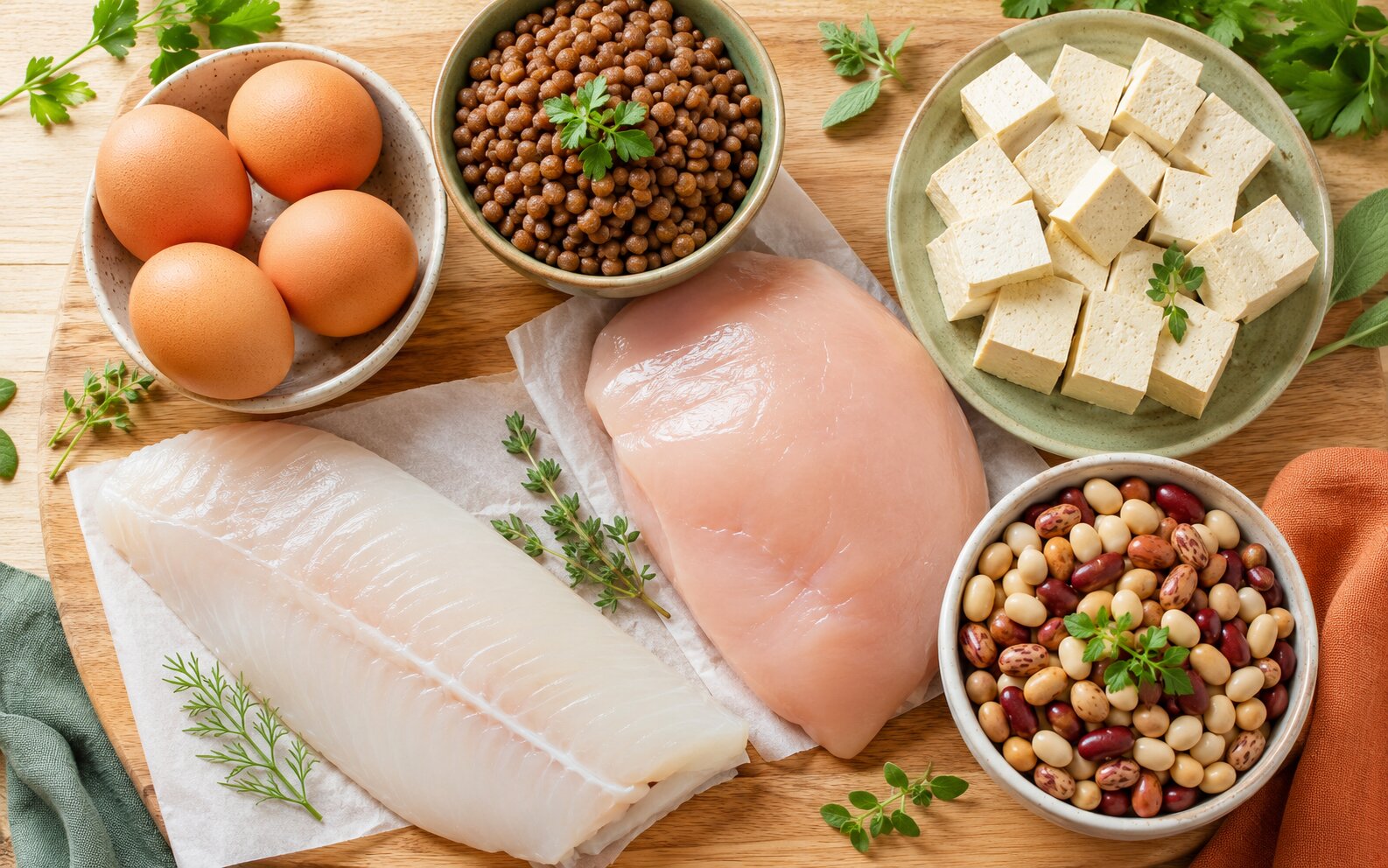
- Eggs — about as efficient as protein gets, cheap, and endlessly flexible. A renal-kitchen MVP.
- Fish and skinless poultry — high-quality protein that's easy to portion and takes beautifully to herbs, citrus, and spice (see Flavor Without Salt).
- Lean fresh meat, in sensible portions — totally on the table; just buy it plain, never pre-marinated or cured.
- Plant proteins like beans, lentils, and tofu — increasingly recognized as kidney-friendly. They bring fiber, create less acid for your body to manage, and let you build meals that don't revolve around meat. Some run higher in potassium or phosphorus, so portion and pairing matter — but you don't have to choose between "all meat" and "all plants." A mix is often the sweet spot.
And the one category to keep at arm's length: processed and cured meats — deli slices, bacon, sausage, hot dogs. They're a double hit of sodium and added phosphates, the opposite of what your kidneys want. Buying your proteins plain is half the battle (we cover the whole grocery run in The Renal Pantry Essentials).
The phosphorus connection most people miss
Here's a wrinkle worth knowing: protein and phosphorus travel together. Protein-rich foods — meat, dairy, beans, nuts — tend to be phosphorus-rich too. And processed proteins pile on added phosphates, which your body absorbs far more readily than the natural kind.
So managing protein and managing phosphorus aren't two separate jobs — they're mostly the same job. The habit that covers both: choose whole, unprocessed proteins, keep portions reasonable, and scan ingredient lists for any word with PHOS in it. The NKF has the full phosphorus rundown if you want to go deeper.
Putting protein on your plate
Enough theory — here's how it actually looks at dinner.
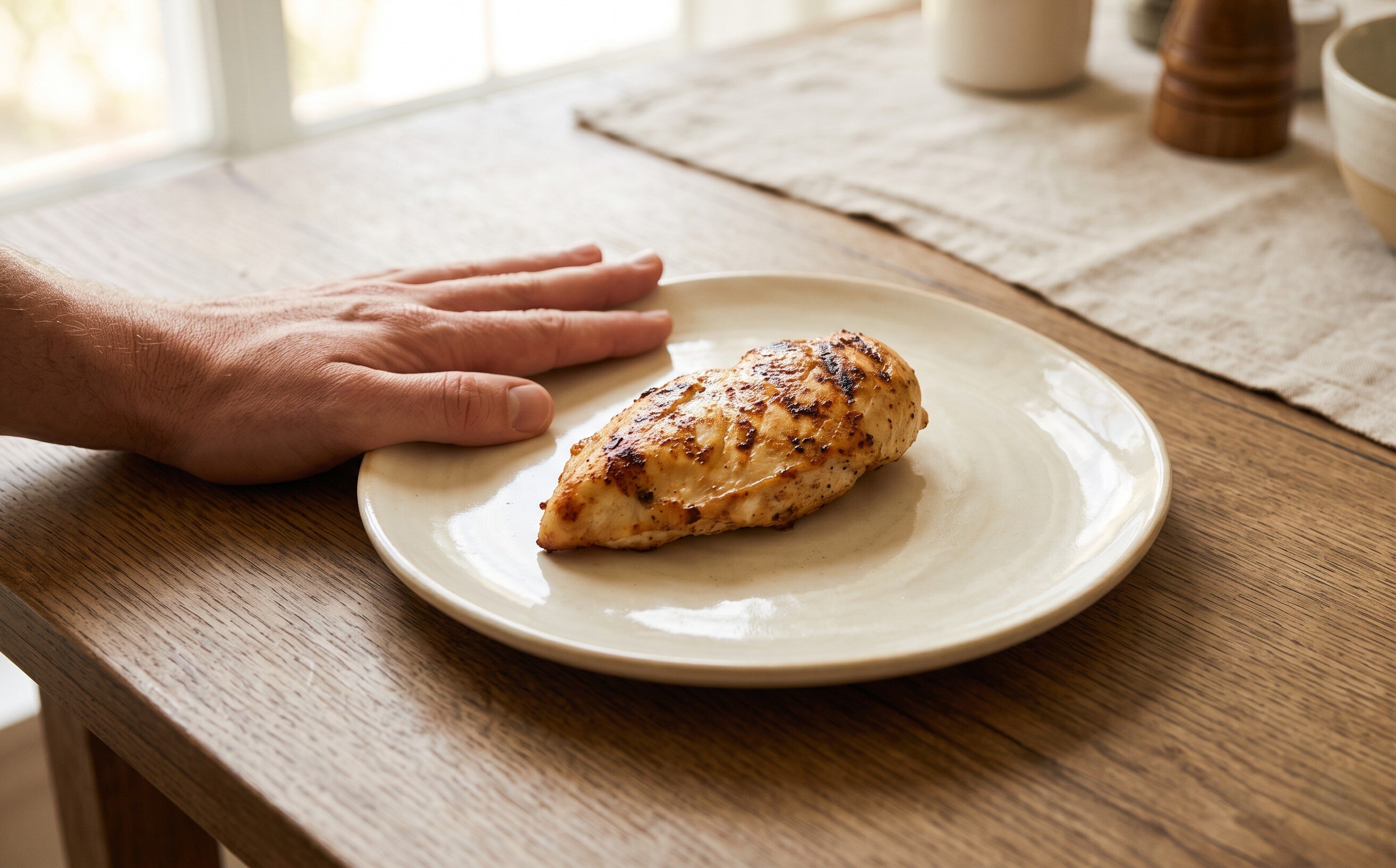
- Picture the portion. A serving of cooked protein is roughly the size of your palm, or a deck of cards — about 3 ounces. You don't need a food scale forever; train your eye once and you'll eyeball it for life.
- Spread it across the day. Your body uses protein better in steady amounts than in one giant hit. A little at breakfast and lunch beats saving it all for a steak the size of a hubcap at night — and a protein-smart snack can fill the gaps.
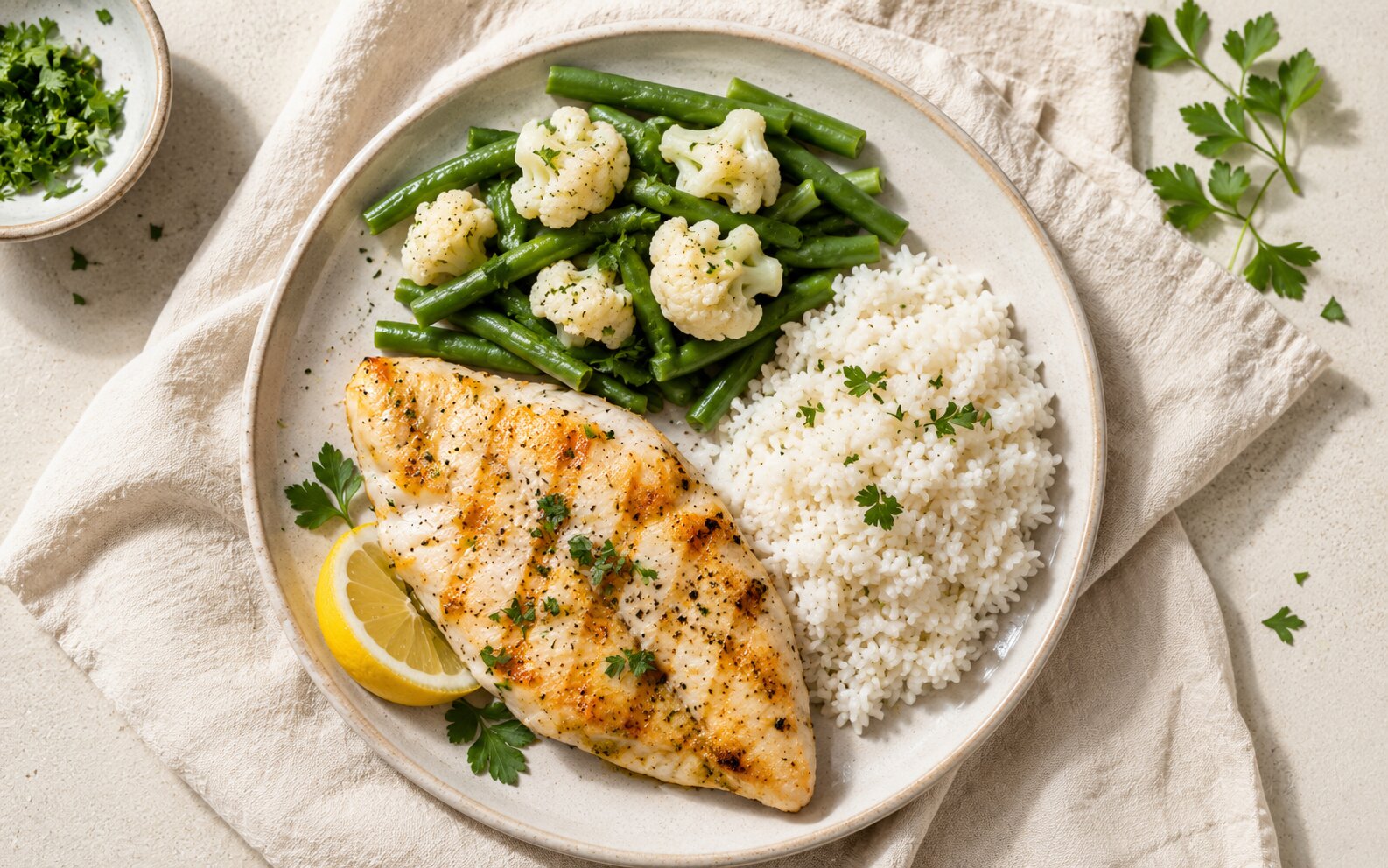
- Let protein share the plate, not dominate it. Treat it as one component, with a low-mineral grain and a couple of lower-potassium vegetables rounding things out. A palm of fish, a scoop of rice, a pile of roasted green beans — that's a renal-friendly plate, and it looks like dinner, not a diet.
A few protein myths worth busting
The internet has done a number on protein. Let's clear up the big ones for the CKD crowd specifically:
- "More protein is always healthier." Gym-culture gospel — and for some athletes, maybe. But if you're not on dialysis, piling on protein adds to your kidneys' workload. More is not the goal here.
- "Protein shakes and powders are an easy win." Tread carefully. Many are sky-high in protein and loaded with phosphate additives — potentially a double problem if you're pre-dialysis. Never add one to your routine without running it past your care team first.
- "Plant protein doesn't really count." It counts plenty — and may even be gentler on your system. Beans and lentils are protein and fiber in one.
- "Eating less protein means feeling weak and starving." Not if you build meals well. Moderate protein, smart carbs, plenty of flavor, and steady timing keep you full and energized. Feeling deprived is a planning problem, not a feature of the diet.
Getting protein right, without the math
Here's the honest truth. Protein management means juggling a lot at once: the right amount for your stage, the right type, the phosphorus that rides along with it, the portion sizes, and — let's not forget — making it all taste good enough that you want to eat it again tomorrow. Doing that math three times a day, every day, is genuinely a lot to carry.
That's the job WizeMeals was built to take off your plate. You tell it your situation, and it builds you a week of real, satisfying meals built around your CKD — protein dialed to your inputs instead of guessed at, phosphorus and sodium handled in the background, and not a spreadsheet in sight.
See it in action with our kidney-friendly meal plans, or build your own menu in about 30 seconds. Bring the protein number your dietitian gives you, and let us handle the cooking part.
You've got this. And Chef Wize has got your back. 👨🍳
References
- Ikizler TA, et al.: KDOQI Clinical Practice Guideline for Nutrition in CKD: 2020 Update (American Journal of Kidney Diseases, 2020): protein targets: 0.55–0.60 g/kg/day pre-dialysis without diabetes (0.6–0.8 with diabetes), rising to 1.0–1.2 g/kg/day on dialysis
- Hahn D, et al.: Low protein diets for non-diabetic adults with chronic kidney disease (Cochrane review, 2020): very-low-protein diets probably reduce progression to end-stage kidney disease in CKD 4–5
- Kalantar-Zadeh K, Fouque D: Nutritional management of chronic kidney disease (New England Journal of Medicine, 2017) — the protein balancing act: too little risks protein-energy wasting while too much adds urea load for failing kidneys
A note from us: WizeMeals builds menus around your CKD using established nutrition guidance — it's a kitchen companion, not a replacement for medical advice. Protein needs are especially individual, so your number should come from your doctor and a registered kidney dietitian who know your stage and your labs. For trustworthy background, see the National Kidney Foundation on how much protein is right and the NIH's NIDDK on healthy eating with CKD.
Your first plan is free
Get a complete week of meals built around your goals — your first full plan is on us.
Build your first plan free →Keep reading
The Celiac Disease Food Guide: Eating Strictly Gluten-Free Without Living in Fear
Newly diagnosed with celiac disease? Here's the complete framework: what gluten actually is, the trust ladder for packaged foods, and how to build meals that are safe without cooking a second dinner.
Eating Out With Celiac Disease: The Three Questions That Keep You Safe
A celiac diagnosis doesn't end restaurant meals. The safest cuisines, the three questions to ask any kitchen, and what to do when you get glutened away from home.
This content is intended for educational purposes and should not replace individualized medical advice. Read our editorial standards.